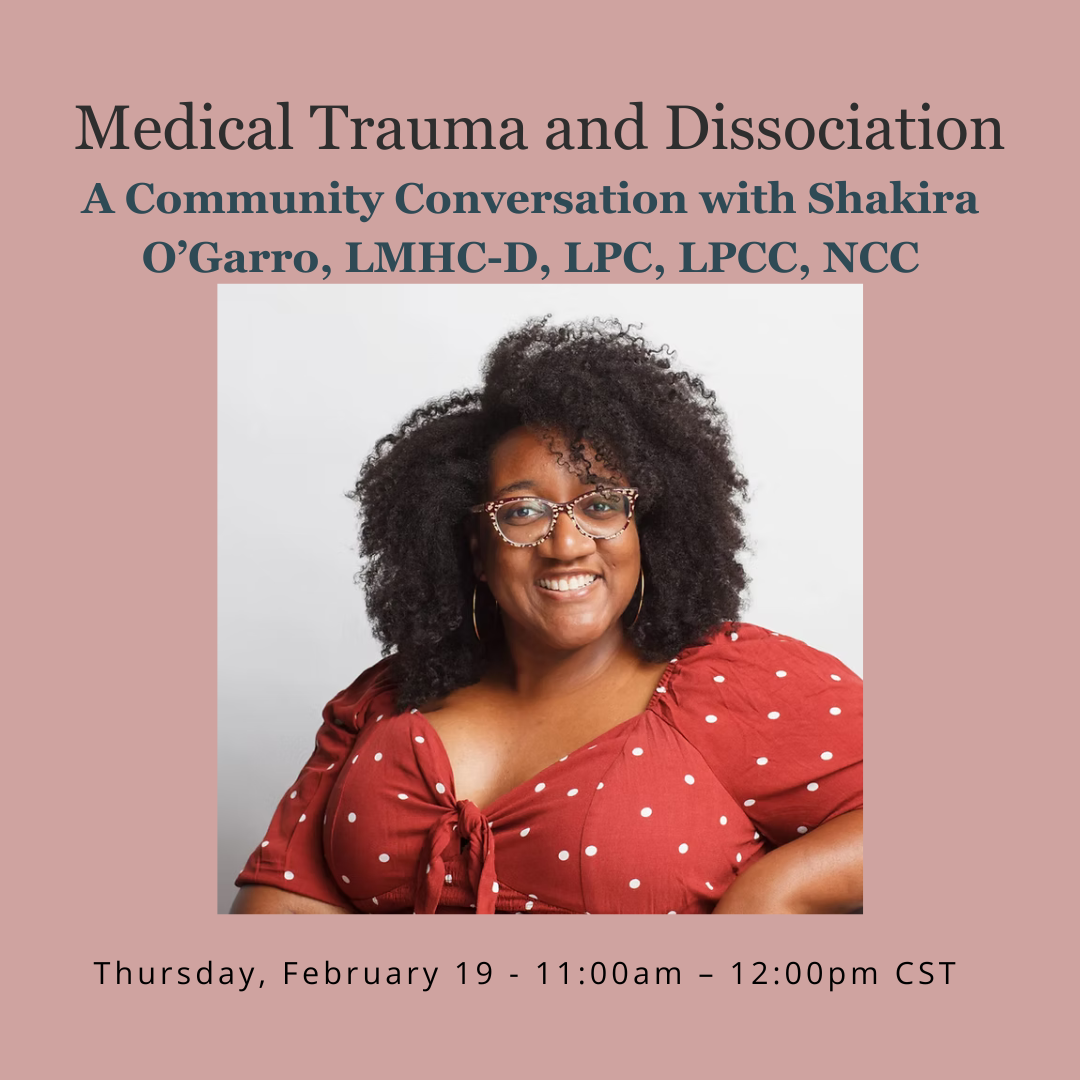
Medical Trauma and Dissociation: A Community Conversation with Shakira O'Garro, LMHC-D, LPC, LPCC, NCC

$17.00

Have you ever felt strangely distant or numb during a medical procedure, almost as if you were watching it happen from somewhere outside yourself?

That experience has a name, and it is far more common than many people realize. Medical trauma can deeply impact the nervous system, and for many people, dissociation becomes an adaptive way of coping with overwhelming or threatening experiences in medical settings. It is not a flaw, and it is not something to fix. It is a protective response, shaped by a body that was doing its best to keep you safe.

In this recorded community conversation, I sit down with licensed therapist Shakira O'Garro, LMHC-D, LPC, LPCC, NCC, to explore the relationship between medical trauma and dissociation. Together we offer a compassionate, educational space to understand dissociation not as something "wrong," but as a meaningful, nervous-system-informed response to fear and overwhelm.

This is a gentle, human-centered conversation about how medical care can impact the body, trust, and sense of safety, and how understanding dissociation can be a first step toward feeling more grounded again.

What we explore together

  • What dissociation is, and why it is a protective response rather than a problem

  • How medical trauma can impact the nervous system, the body, and your sense of safety

  • The many forms dissociation can take, from numbing to feeling far away from yourself

  • Why understanding your responses with compassion matters more than judging them

  • Gentle ways to begin reconnecting with your body and feeling safer again

What you receive

An on-demand video conversation you can watch anytime, at your own pace, returning to it as often as you need. There is no schedule to keep and no pressure to get it "right." Just a warm, reflective conversation you can sit with whenever the timing feels right for you.

This conversation is offered for educational and informational purposes only. It is not therapy, counseling, or medical advice, and it is not a substitute for care from a licensed professional. Watching this recording does not create a therapeutic or client relationship with me or with my guest. If you are struggling or in crisis, please reach out to a qualified mental health professional, your doctor, or your local emergency services.

Have you ever felt strangely distant or numb during a medical procedure, almost as if you were watching it happen from somewhere outside yourself?

That experience has a name, and it is far more common than many people realize. Medical trauma can deeply impact the nervous system, and for many people, dissociation becomes an adaptive way of coping with overwhelming or threatening experiences in medical settings. It is not a flaw, and it is not something to fix. It is a protective response, shaped by a body that was doing its best to keep you safe.

In this recorded community conversation, I sit down with licensed therapist Shakira O'Garro, LMHC-D, LPC, LPCC, NCC, to explore the relationship between medical trauma and dissociation. Together we offer a compassionate, educational space to understand dissociation not as something "wrong," but as a meaningful, nervous-system-informed response to fear and overwhelm.

This is a gentle, human-centered conversation about how medical care can impact the body, trust, and sense of safety, and how understanding dissociation can be a first step toward feeling more grounded again.

What we explore together

  • What dissociation is, and why it is a protective response rather than a problem

  • How medical trauma can impact the nervous system, the body, and your sense of safety

  • The many forms dissociation can take, from numbing to feeling far away from yourself

  • Why understanding your responses with compassion matters more than judging them

  • Gentle ways to begin reconnecting with your body and feeling safer again

What you receive

An on-demand video conversation you can watch anytime, at your own pace, returning to it as often as you need. There is no schedule to keep and no pressure to get it "right." Just a warm, reflective conversation you can sit with whenever the timing feels right for you.

This conversation is offered for educational and informational purposes only. It is not therapy, counseling, or medical advice, and it is not a substitute for care from a licensed professional. Watching this recording does not create a therapeutic or client relationship with me or with my guest. If you are struggling or in crisis, please reach out to a qualified mental health professional, your doctor, or your local emergency services.

Community Conversations are included at no additional cost for members of the Befriend Your Body Community.

The community is a trauma-informed, peer-support space for people impacted by medical trauma, designed to help you feel safer in your body and less alone in your experience.

When you join the community, you receive access to:

✨ Community Conversations
Live, educational conversations with trauma-informed clinicians and practitioners on topics related to medical trauma, the nervous system, and healing.

🌱 The Foundation
A self-paced introduction to medical trauma and the nervous system, offering education and gentle practices to help you build understanding, capacity, and self-agency.

🤍 Weekly Peer Support
Regular peer-led support spaces where you can connect with others who truly understand the impact of medical trauma, in a compassionate and non-judgmental environment.

🌊 Community Support
An ongoing, moderated community space to share, reflect, and receive support between live gatherings—at your own pace.

🌀 Somatic Practices
Nervous-system-based practices designed to support regulation, grounding, and reconnection with your body in gentle, accessible ways.

Many people find that joining the community offers ongoing support beyond a single event.

You’re welcome to join in whatever way feels most supportive for you right now. https://your-bc-befriend.mn.co/landing/